
Since 2026
Finding under-coded stays in medical discharge summaries
How a stay is coded determines what the facility is paid. An AI-assisted review flags under-rated severity levels, and the doctor decides.
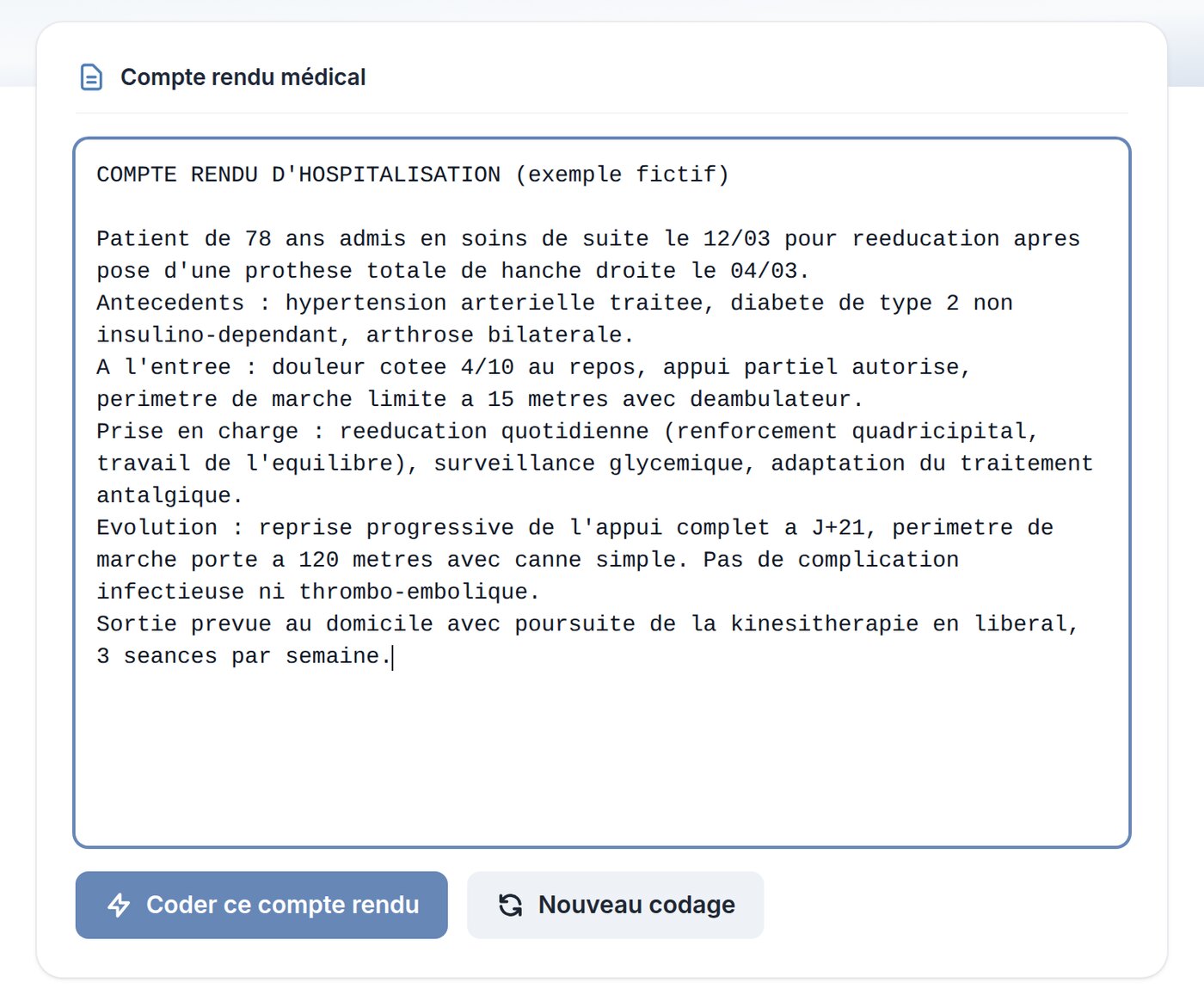
stays whose severity level was under-rated, across the usable records analysed
real archived files the measurement was made on, and which can be replayed
The context
In rehabilitation care, how a stay is coded — diagnoses, dependency, procedures — directly determines what the facility receives. Coding is done by care staff, under time pressure, from summaries written in free text. Information that is present in the record but not coded is a pure loss, invisible, and never discovered. Nobody has time to reread hundreds of stays to find it.
The workflow, in motion
The diagram below replays what has just been described, step by step. It is not an illustration: it is the real path a file takes through the tool.
From the patient record to a properly funded stay
AI reads the discharge report, extracts the diagnoses, classifies them, derives the case-mix group and flags what is missing for the stay to be funded at its true level.
- 78-year-old patient admitted to rehabilitation after a left middle cerebral artery infarction.
- Right spastic hemiplegia, daily motor rehabilitation.
- History: hypertension, type 2 diabetes.
- Swallowing disorders: pureed diet, speech therapy assessment under way.
- Dependency: assistance required for transfers and washing.
keyFunding-relevant keywords
medical_informationDiagnoses classified and coded
categoryCase-mix group
paymentsFunding for the stay
lightbulbThe swallowing disorders are described but not coded: that associated diagnosis moves the stay to severity 2 — GME 0147UB1 → 0147UB2.
lightbulbThe dependency described puts the daily-living scores in the 9-12 range: level B confirmed, pending the doctor's approval.
Fictional case, real ICD-10 codes and tariffs. In production every suggestion quotes the sentence in the record that backs it — the doctor keeps the decision.
What we did
- check_circleReading the discharge summaries and extracting the elements that carry coding value: diagnoses, manifestations, dependency, rehabilitation procedures.
- check_circleComparison against the coding actually entered, to surface the gaps — and only the gaps, so the doctor is not buried under confirmations.
- check_circleTraceability of every suggestion back to the sentence in the summary that justifies it. A suggestion you cannot trace to its source is not verifiable, therefore not usable.
- check_circleMeasuring the error rate on archived files where the right answer is known, before any production use — and a script that replays the measurement on demand.
- check_circleValuation computed on the official tariff schedule in force, not on an estimate: the gap shown is a real amount.
What changed
- trending_upUnder-coded stays surface before closing, while there is still time to correct them.
- trending_upThe doctor stays in control: the tool proposes and justifies, it does not code. Every validation is traced.
- trending_upThe error rate is measured and reproducible, not asserted. That is what makes the tool debatable with a doctor, instead of a black box.
- trending_upWhat is not reliable is not automated. Cases where the summary does not allow a conclusion are flagged as such, not guessed.
The services involved
This engagement drew on the following expertise. Each has its own page, with its method and its deliverables.
Other case studies
STS Arbres et Jardins
Since 2026A one-year-old site built on an abandoned theme, with an American contact page still live. Full rebuild, migration off WordPress, and local pages built on verified facts.
Read the case studyarrow_forward
FlatBay
Since 2015Agencies drowning in incomplete files. An assistant that chases missing documents, computes the affordability ratio, and only passes on complete applications.
Read the case studyarrow_forward
Gextra
Since 2010Admissions, care records, staff scheduling, billing, mobile apps. A complete business system, being migrated screen by screen to modern technology without stopping the work.
Read the case studyarrow_forwardLet's talk about your project
Thirty minutes is enough to tell whether we are the right fit. We reply within 48 hours, and we say no when it is not for us.